On Jewish tombstones you will sometimes see a symbol showing two hands arranged for the Priestly Blessing like the example here. This is a symbol of the Kohen or Cohen (Hebrew for priest). The plural form is Kohanim or Cohanim. Kohanim are assumed to be direct male descendants of Aaron, who was the first Kohen and the brother of Moses. Some Jewish surnames frequently associated with this symbol are Conn or Cohn (Kohn), Cahn (Kahn), and Cohen (Kohen), but you will find the symbol on the grave markers of people with other surnames. Today families can sometimes verify a priestly lineage from the tombstones of ancestors that have this symbol.
Mr. Spock’s Vulcan Salute
And yes, Star Trek fans… You’ve probably noticed the similarity between this symbol and the Vulcan hand greeting (“live long and prosper”) used in the TV show and movies. This was suggested by actor Leonard Nimoy (Mr. Spock), who saw the Priestly Blessing in a synagogue when he was a child. He modified it as Vulcans use only one hand. See: The Jewish Origin of the Vulcan Salute
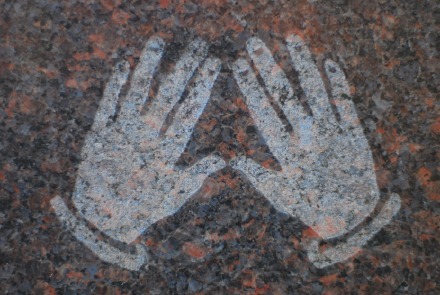
Photo: from Fairmount Cemetery, Denver, Colorado


 Cemeteries and Cemetery Symbols
Yet another reason to love Mr. Spock! Once again, I’m thankful for these informative, interesting, and intriguing entries. Please keep posting!
This is a nice tale that Leonard Nimoy has told several times on tv documentaries concerning the history, deveopment and impact of star trek.
It is interesting that there is tremendous impact ( a lot of unknown) from this small group of wandering nomads.
Interestingly the very concept of America – of the frontier spiirt – can be traced back to Jewish ranchers who left the coming Spanish Inquisition in Mexico for areas further west – such as texas and new mexico whrere they continued their livelihood with a peacefull coexistence with the local indians.
The stick was used in Europe at the time to herd cattle.
Eventually the lasoo of the American Indian replaced the herding stick of Europe as the dominant tool of the cattle herder – yet the name stuck as a term for cowboys as “Cowpoke”
This is interesting. I wonder if anyone has published a complete guide to symbolizm on monuments and memorials. I have read quite a few, but have never heard or seen this one before. I guess living in small town Iowa, we have a very small Jewish poulation.
Great Post
I was really interested in that “hands” sign which I saw on one of the tombs in Prague’s Old Jewish Cemetetery. Cemetery’s book store has Jewish signs book. It was explaining many signs from that cemetery. Unfortunately the book was in Checz.